What Gentle Stretching Really Means (and Why It's Not Just Beginner Stretching)
When I first started stretching years ago, I made the same mistake most people do: I pushed until I felt a sharp pull, held my breath, and counted to ten. I thought that was the price of progress. It wasn't. It took a mild muscle strain and a week of hobbling to learn that gentle stretching is not about how far you can reach - it's about how calmly you can breathe into a mild sensation.
Gentle stretching is an intentional, low-intensity practice. It's not 'beginner stretching' with easier poses. It's a distinct approach where the goal is to ease into a comfortable stretch, hold it without strain, and let your nervous system settle. You're not chasing flexibility; you're inviting it.
In this guide, I'll show you exactly how to do that - with chair modifications, breath cues, a 6-week progression, and honest advice on when stretching is the wrong move. You'll learn what 10 minutes a day can actually do (and what it can't), and you'll walk away with a routine you can start tonight.
Why Gentle Stretching Is Different from Standard Beginner Routines
Most 'beginner stretching' articles assume you're healthy, mobile, and just new to the movements. They throw you into a standing hamstring stretch or a deep lunge and say 'hold for 30 seconds.' But if you're over 60, recovering from an injury, or haven't moved much in months, that advice can do more harm than good.
Gentle stretching flips the priority: instead of aiming for a specific range of motion, you aim for a specific level of sensation - a 2 or 3 on a 10-point scale, where 0 is nothing and 10 is intense pain. You never go above a 4. You also modify everything to your body's current reality, using chairs, walls, towels, and shorter holds.
The thing nobody tells you about gentle stretching is that it's actually harder than aggressive stretching in one way: it requires more patience and self-awareness. You have to resist the urge to push. But that patience pays off with fewer injuries and more consistent progress.
The Easiest Stretches to Start With (Even If You're Stiff or in Pain)
If you're brand new, start with these five stretches. Each one can be done seated in a chair or on the floor, and I'll give you the gentlest version possible. These are the easiest because they target large muscle groups without requiring balance or joint stress.
1. Neck Tilts
Sit tall, relax your shoulders. Slowly tilt your ear toward your shoulder, stopping when you feel a mild pull on the opposite side of your neck. Hold for 20-30 seconds, breathing normally. That's it. If you feel any sharp pain, stop immediately.
Most people hold tension in their neck without realizing it. This stretch is a safe way to release it, but never force your ear closer to your shoulder - let gravity do the work.
2. Shoulder Rolls (Not a Stretch, But a Great Warm-Up)
Roll your shoulders backward in slow circles, then forward. Do 5 each direction. This isn't a static stretch, but it prepares your upper body for the stretches that follow. It also helps you notice where you're holding tension.
3. Seated Cat-Cow (Spine Mobility)
Sit on a chair with your hands on your knees. Inhale, arch your back and look slightly up. Exhale, round your spine and tuck your chin to your chest. Move slowly with your breath. Do 5-6 rounds. This gently mobilizes your spine without putting weight on your wrists or knees.
4. Seated Hamstring Stretch (on a Chair)
Sit near the front of a chair. Extend one leg straight, heel on the floor, toes pointing up. Keep your back straight and hinge forward from your hips only until you feel a mild stretch behind your thigh. Hold for 20-30 seconds. If your back rounds, you've gone too far - sit up taller.
This is one of the easiest ways to stretch your hamstrings because the chair supports your weight. Over time, you can place a towel under your heel to reduce friction, or eventually do this on the floor.
5. Calf Stretch (Seated or Standing)
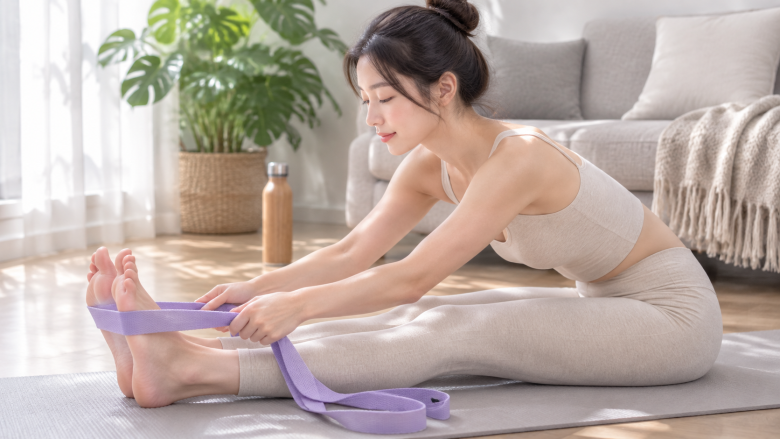
Seated: Extend one leg, loop a towel around the ball of your foot, and gently pull your toes toward you. You should feel it in your calf. Hold for 20 seconds. Standing (if balance allows): Place your hands on a wall, step one foot back, keep the heel down, and bend the front knee slightly.
These five stretches take about 5 minutes. They're perfect for a first session. But the real skill is learning how to tell if you're doing them gently enough.
The 'Just Right' Scale: How to Tell Tension from Pain
One of the biggest mistakes I see from new stretchers is treating all discomfort as the same thing. They think if it hurts a little, it's working. That's dangerous. Here's a simple scale I teach my clients:
- 0-1: No sensation. You're not stretching enough - that's fine for a warm-up, but for a true stretch you want a little more.
- 2-3: A mild, comfortable pull. This is your target zone for gentle stretching. You can breathe deeply and hold a conversation.
- 4: A noticeable but still tolerable stretch. The upper limit for gentle work. If you're new, stay here briefly.
- 5+: Strong pulling, burning, or sharp pain. Stop immediately. This is your body telling you something is wrong.
Sharp, stabbing, or shooting pain is never acceptable. Neither is numbness or tingling. Those are red flags for nerve compression or injury. If you feel them, back off completely and consider seeing a physical therapist.
Most people don't realize that stretching should never cause pain that lasts longer than 30 minutes after the session. If you're sore the next day, you pushed too hard. Gentle stretching should leave you feeling relaxed, not beaten up.
What 10 Minutes of Daily Gentle Stretching Will Actually Do
You've probably seen headlines about '10-minute stretches that transform your body.' Let's be honest: 10 minutes a day won't make you a contortionist. But it will do something more valuable for a beginner: it will teach your body to move with less fear and more ease.
Here's what you can realistically expect after 4-6 weeks of consistent daily practice:
- Reduced morning stiffness: Gentle stretching increases blood flow to muscles, which helps you feel less creaky when you get out of bed.
- Improved posture: Stretching tight chest and hip muscles (which we all have from sitting) allows your spine to align more naturally.
- Better circulation: Moving your muscles pumps blood back to your heart, which is especially helpful if you sit all day.
- Lower stress levels: Deep breathing during stretches activates your parasympathetic nervous system, the 'rest and digest' mode.
But here's the honest limitation: 10 minutes a day won't dramatically increase your flexibility unless you're very consistent and gradually increase the intensity. For that, you need a progression plan - which I'll give you next.
If you're looking for a more structured daily practice, check out our guide on building a simple morning stretching routine. It complements this approach perfectly.
The 6-Week Gentle Progression Plan (Your Roadmap to Safe Flexibility)
Most beginner stretching programs just say 'do these stretches' and leave you there. But your body adapts quickly, and if you never increase the challenge, you'll plateau. The key is to increase intensity gradually, not by pushing deeper but by adding time and variety.
Here's a week-by-week plan that respects your body's need for adaptation:
Weeks 1-2: Foundation and Breath (5-7 minutes daily)
Focus on the five stretches from above. Hold each for 15-20 seconds, not 30. Use the 'just right' scale and keep every stretch at a 2-3. Breathe slowly and deeply. The goal is to teach your body that stretching is safe, not to increase range.
Do this every day. Missing a day is fine, but consistency matters more than intensity here.
Weeks 3-4: Increase Hold Time and Add Two New Stretches (10 minutes)
Now you can hold each stretch for 25-30 seconds. Add two new stretches: a seated spinal twist and a lying glute stretch (if you can get on the floor). For the spinal twist, sit sideways on a chair, twist gently to look over your shoulder, and hold. For the glute stretch, lie on your back, cross one ankle over the opposite knee, and gently pull the thigh toward your chest.
If you can't get on the floor, do the glute stretch seated by crossing your ankle over your knee and gently pressing down on your knee. Keep everything at a 3-4 on the scale.
Weeks 5-6: Add Deeper Variations and Longer Holds (10-12 minutes)
Now you can try a few floor stretches if you're comfortable: a lying hamstring stretch (using a strap or towel), a child's pose, and a gentle figure-four stretch. Hold each for 30-45 seconds. You can also start to experiment with slightly deeper versions of the seated stretches, but always stay within a 4.
By the end of week 6, you'll notice you can sit taller and reach a little further without pain. That's your sign to either continue with this routine or gradually add more challenging stretches.
For a more complete movement plan that includes gentle strengthening, see our gentle home exercise plan for beginners. It pairs well with stretching for overall health.
Gentle Stretches for Seniors and Very Deconditioned Beginners
If you're a senior or have been inactive for a long time, your body has specific needs. You might have reduced balance, joint stiffness, or chronic conditions like arthritis. The good news: gentle stretching is ideal for you. The key is to do everything seated or with support.
Here are some of the easiest and safest stretches for older adults:
- Seated Hamstring Stretch (as described earlier): Use a chair with a back for support. Keep your back straight and hinge only a few degrees.
- Seated Calf Stretch: Same as the hamstring stretch, but instead of pulling your toes up, press your heel down and lift your toes slightly. Hold for 15-20 seconds.
- Seated Ankle Rolls: Lift one foot slightly and rotate your ankle in circles. This improves ankle mobility, which is crucial for balance.
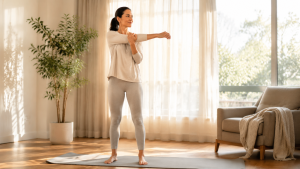
- Seated Shoulder Stretch: Reach one arm across your chest and gently pull it with the other hand. Keep your shoulders relaxed.
- Seated Neck Stretch: As described earlier, but keep your chin tucked to avoid straining the back of your neck.
If you're very deconditioned, start with just 2-3 stretches for 5 minutes a day. Use a wall for balance if you're standing. Always hold onto something when getting up or down from a chair.
One caution for seniors: avoid rapid neck rolls or deep forward bends that could cause dizziness. Move slowly and never hold your breath. If you feel lightheaded, stop immediately.
Also, if you have osteoporosis, avoid spinal flexion (rounding forward). Instead, focus on extension (arching back) and rotation. Always consult your doctor before starting any new exercise program, especially if you have chronic conditions.
When NOT to Stretch: Injury, Nerve Pain, and Red Flags
Gentle stretching is not a cure-all. There are times when stretching is exactly the wrong thing to do. Here's when to skip it and see a professional instead:
- Acute muscle or joint injury: If you just pulled a muscle or sprained an ankle, don't stretch it. Ice and rest for 48 hours. Stretching a torn muscle makes it worse.
- Nerve pain: If you feel shooting pain, numbness, or tingling down your arm or leg, that's a sign of nerve compression (like sciatica). Stretching can aggravate it. See a physical therapist.
- Herniated disc: Stretching, especially forward bends, can worsen a disc herniation. Avoid any stretch that causes pain in your lower back or legs.
- Recent surgery: Wait for your doctor's clearance. Stretching too soon after surgery can disrupt healing tissues.
- Fever or acute illness: Your body needs rest, not stretching.
Even with gentle stretching, if you feel a sharp pain in a joint (not muscle), stop. Joint pain is different from muscle tension. Muscle tension feels like a dull, achy pull. Joint pain feels sharp and localized in the knee, hip, or shoulder.
A good rule: if a stretch hurts in the joint, you're doing it wrong. Back off and modify the position. For example, if a seated forward fold hurts your lower back, try placing a pillow under your knees or propping yourself up on a folded blanket.
How to Go Gentler: Modifications, Props, and Shorter Holds
Even within the 'gentle' category, you can always go softer. This is crucial for days when you're tired, sore, or just not feeling it. Here are five ways to make any stretch gentler:
- Use a chair: Almost every standing stretch can be done seated. If you're doing a hamstring stretch, sit instead of standing.
- Reduce the range: Don't go as far. If you can only lean forward 5 degrees, that's fine. The stretch is still happening.
- Shorten the hold: Instead of 30 seconds, hold for 10-15 seconds. Do more repetitions if you want.
- Use a prop: A towel, strap, or pillow can support your body and reduce the intensity. For example, place a rolled towel behind your knees in a forward fold.
- Breathe more: Exhale as you ease into the stretch. Inhale as you release. This alone can drop the sensation level by a full point.
Most people don't realize that a stretch doesn't have to be static. You can do gentle dynamic movements - like slow arm circles or leg swings - that are even lower intensity than static holds. These are great for warming up.
Another underused trick: stretch after a warm shower. Warm muscles are more pliable, so you'll feel a greater stretch without pushing harder.
Breathing and Relaxation: The Missing Piece of Gentle Stretching
You can do all the right stretches, but if you're holding your breath, you're missing half the benefit. Gentle stretching is as much about your nervous system as it is about your muscles. When you breathe slowly and deeply, you signal to your brain that you're safe. That signal allows your muscles to relax and lengthen more easily.
Here's a breathing pattern I teach my clients:
- Before you start a stretch, take a slow inhale through your nose for 4 seconds.
- Exhale slowly through your mouth for 6 seconds, and as you exhale, ease gently into the stretch.
- Hold the stretch for 2-3 full breath cycles, maintaining that slow, even rhythm.
- On an inhale, slowly release the stretch.
This 4-6 breathing pattern (inhale 4, exhale 6) activates your parasympathetic nervous system. It's the same technique used in yoga and meditation. It's not just relaxation - it's biomechanically effective because a longer exhale decreases your heart rate and reduces muscle tension.
If you find your mind wandering, that's fine. Just bring your attention back to your breath. The goal is to stay present, not to achieve a perfect pose.
A Sample 10-Minute Gentle Stretching Routine (With Breath Cues)
Here's a full routine you can do right now, either in a chair or on the floor. I've included breath cues and modifications. Do this every day for the first two weeks.
Start with 2 minutes of slow breathing. Sit or lie down, close your eyes, and breathe in for 4, out for 6. This prepares your nervous system.
- Seated Neck Tilts (1 minute): Inhale tall, exhale tilt ear to right shoulder. Hold 3 breaths. Inhale back to center, exhale to left. Repeat twice each side.
- Seated Cat-Cow (2 minutes): Inhale arch, exhale round. Move slowly with your breath. Repeat 6-8 times.
- Seated Hamstring Stretch (2 minutes): Extend right leg, inhale tall, exhale hinge forward slightly. Hold 3 breaths. Switch legs.
- Towel Calf Stretch (2 minutes): Loop a towel around the ball of your right foot. Inhale, exhale gently pull toes toward you. Hold 3 breaths. Switch.
- Seated Spinal Twist (2 minutes): Sit sideways in a chair, twist to the right, looking over your shoulder. Hold 3 breaths. Switch side.
- Finish with 1 minute of stillness. Sit quietly, breathe normally, notice how your body feels.
That's 10 minutes. If you have more time, add the glute stretch or a child's pose from the floor.
Remember, you can always shorten holds or skip a stretch if you're not feeling it. The routine is a guide, not a test.
Common Mistakes Beginners Make (and How to Avoid Them)
Even with good intentions, we all make mistakes. Here are the most common ones I've seen (and made myself):
- Bouncing: Ballistic stretching (bouncing) is not gentle and can cause microtears. Always move slowly.
- Holding your breath: This increases tension and makes stretching less effective. Always breathe.
- Stretching cold muscles: A 5-minute walk or gentle arm swings can warm you up. Stretching cold muscles can strain them.
- Comparing yourself to others: Your flexibility is unique. The person next to you might be able to touch their toes, but that doesn't mean you're failing.
- Stretching a muscle that's already torn: If you feel a sudden sharp pain, stop. Don't 'work through it.'
One mistake I still catch myself making is rushing. I'll think, 'I only have 5 minutes, so I'll push harder to make it count.' That's backwards. Gentleness is the goal. If you only have 5 minutes, do 3 stretches slowly. That's better than rushing through 10.
Final Thoughts: Start Slow, Stay Consistent, and Listen to Your Body
Gentle stretching is not a race. It's a daily practice of returning to your body with kindness. The benefits - less stiffness, better posture, calmer mind - accumulate over months, not days. But they do accumulate.
If you take one thing from this article, let it be this: the best stretch is the one you can do without pain, with breath, and with consistency. That's it. Everything else is details.
Start tonight with just the five basic stretches. Tomorrow, add the breathing pattern. By the end of the week, you'll have a routine that fits into your life without feeling like a chore. And if you miss a day, no big deal. Just come back to it. Your body will thank you.