Most nutrition advice tells you what to put on your plate, but completely ignores the clock. You can build a perfect half-vegetable, quarter-protein, quarter-grain plate and still feel ravenous two hours later. That is because balanced eating is not just about the what - it is also about the when and the why. After years of coaching clients and fixing my own erratic eating habits, I have found a simple system that combines both: the 3-3-3 Rule plus the Plate Method. You get a visual template for every meal, and a timing framework that keeps your blood sugar steady and your energy level. Here is how it works, why it works, and how to adapt it to your real life.
The 3-3-3 Rule: What It Is and Why It Works
You have probably heard of the 3-3-3 rule for meals from a friend or a fitness influencer. But what does it actually mean? The rule is simple: eat 3 meals per day, spaced roughly 3 hours apart, and each meal should contain the 3 key macronutrients - protein, fat, and carbohydrate. That is it. No counting calories, no forbidden foods, no complicated macros.
Most people get the first part right - they eat three meals - but they space them 5 or 6 hours apart, or they skip meals and then binge. The three-hour interval is the secret. When you eat a balanced meal, your blood sugar rises and then falls. If you wait too long, blood sugar drops below a comfortable level, triggering hunger, irritability, and cravings for quick sugar. By eating every three hours, you keep that curve smooth, avoiding the spike-and-crash cycle.
I remember when I first tried this rule. I was a graduate student with a terrible habit of eating a big breakfast, then nothing until 2 PM, then a huge dinner. My energy crashed every afternoon, and I could not focus. When I started setting a timer for three hours after breakfast - and actually eating a small lunch even if I was not starving - the difference was immediate. My afternoon fog disappeared, and I stopped craving sugary snacks at 3 PM. The physiological reason is well-documented: stable blood glucose levels are linked to better cognitive performance and fewer cravings, according to research on carbohydrate metabolism from Harvard's Nutrition Source.
But the 3-3-3 rule is not just about timing. The three macronutrients matter because they digest at different rates. Protein takes the longest to leave your stomach, fat slows digestion further, and carbohydrates provide quick energy. If you eat a meal that is mostly carbs - like a bagel with jam - you get a fast spike and a fast crash. If you add protein and fat, the release of energy is gradual and sustained. That is why each meal needs all three.
A Practical Example
Let me give you a real day. Breakfast at 8 AM: Greek yogurt (protein), berries (carb), and a sprinkle of walnuts (fat). Lunch at 11 AM: a salad with grilled chicken (protein), avocado (fat), and quinoa (carb). Dinner at 2 PM? No, wait - that is three hours after lunch, but you are not having dinner at 2 PM unless you are a toddler. The rule is flexible: if you eat breakfast at 8, lunch at 11, then you have a snack at 2, and dinner at 5 or 6. The 3-3-3 rule is not a rigid schedule; it is a minimum spacing to avoid long gaps. In practice, you might have three meals plus a snack, but the principle is that you never go more than 3-4 waking hours without a balanced mini-meal.
Here is what most people don't realize: the 3-3-3 rule works best when you also follow the Plate Method, because the timing alone does not guarantee balanced macronutrients. A bag of chips is a carbohydrate and a fat, but it lacks protein. So the rule and the plate go hand in hand.
The Plate Method: A Visual Framework for Balanced Meals
The Plate Method is the most intuitive way to build a balanced meal without weighing food or tracking macros. You divide your plate into sections: half vegetables, one-quarter protein, and one-quarter carbohydrates (preferably whole grains or starchy vegetables). This is the same principle behind the USDA MyPlate and Harvard's Healthy Eating Plate, but the execution is where most people get lost.
Let me clarify what counts as each section. The vegetable half includes any non-starchy vegetable - leafy greens, broccoli, peppers, tomatoes, cauliflower. It does not include potatoes or corn, which are starchy and belong in the carbohydrate quarter. The protein quarter includes meat, fish, eggs, tofu, tempeh, legumes (beans and lentils are also protein, but they have carbs too - more on that later). The carbohydrate quarter is for whole grains like brown rice, quinoa, oats, or starchy vegetables like sweet potatoes and winter squash.
If you look at the Harvard Healthy Eating Plate, you will notice they also add a serving of healthy fats (like olive oil or avocado) and a glass of water or other calorie-free drink. Those are important, but for the plate to be visually balanced, you do not need a separate section for fats - they come from the protein (if oily fish or nuts) or from a dressing or cooking oil.
Here is a common mistake: people fill half their plate with vegetables, but then the protein and carb portions are both too large. I have seen clients proudly show me a plate with a huge chicken breast (protein) and a mountain of rice (carb), and the vegetables are a small side. The plate method is not about exact proportions - it is about visual dominance of vegetables. If you are eating a massive steak, you do not need to cram it into a quarter; you need to make the vegetables fill half the plate first, then add the steak and rice in whatever space remains.
To make this easier, I recommend using a standard nine-inch plate. If you use a dinner plate that is 11 inches across, you will fill it with more food, and the proportions get distorted. A smaller plate naturally forces you to keep portions in check. This is a trick I learned from portion-control studies - people consistently eat less when they use smaller plates, and the visual cue of a full plate tricks your brain into feeling satisfied.
How to Answer: "How Do You Eat a Balanced Meal?"
The direct answer is: fill half your plate with vegetables, a quarter with protein, and a quarter with whole grains or starchy vegetables, and add a source of healthy fat. But the real answer is more nuanced. You need to consider that legumes (beans, lentils, chickpeas) are both protein and carbohydrate. If you eat a bean burrito, you do not need a separate grain - the beans cover both sections. Similarly, dairy like Greek yogurt is a protein and a carb (lactose), but it is fine to count it as protein.
For most adults, a balanced meal also includes a serving of fruit or a source of fiber, but the plate method focuses on the main meal. If you are building a smoothie, the same principles apply: half the volume should be vegetables (spinach, kale, cucumber), a quarter protein (Greek yogurt, protein powder, tofu), and a quarter carbs (banana, berries, oats), plus a fat (nut butter, chia seeds).
The plate method is not a one-size-fits-all prescription. Athletes need more carbs, older adults need more protein to prevent muscle loss, and people with diabetes may need to adjust the carbohydrate quarter to a smaller size. The key is to start with the visual template and then adjust based on your hunger, energy, and health goals.
The 12 Foods You Should Eat Every Day (and Why That's a Trap)
A common question I see online is "What are the 12 foods you should eat every day?" This usually comes from a listicle about nutrient-dense superfoods - like spinach, salmon, blueberries, walnuts, and so on. While those foods are undeniably healthy, the idea that you must eat a specific 12 foods daily is rigid and unrealistic for most people.
I have had clients who became so obsessed with consuming a specific set of "must-have" foods that they felt guilty if they missed one. That guilt does more harm than the missed food. The research on dietary patterns consistently shows that a healthy diet according to the World Health Organization is about variety, balance, and moderation - not a fixed checklist.
Instead of a rigid list, I recommend aiming for a diverse range of foods across the week. The American Heart Association suggests eating a variety of fruits, vegetables, whole grains, lean proteins, and healthy fats. To make it practical, think of 12 categories rather than 12 specific foods. For example: dark leafy greens, colorful vegetables, berries, citrus fruits, whole grains, beans and lentils, nuts and seeds, fatty fish, lean poultry, eggs, low-fat dairy, and herbs/spices. If you hit at least 8 of these categories in a week, you are doing great.
But if you want a daily baseline, here is a simple framework: make sure your plate includes at least one vegetable, one fruit (or a second vegetable), one source of protein, one whole grain, and one healthy fat. That is 5 components, not 12. The 12-food list is a clickbait myth that distracts from the real goal: consistent balanced meals.
I learned this the hard way when I tried to follow a "12 foods" list from a popular blog. I spent a fortune on exotic ingredients, ended up throwing away half of them, and felt like a failure. The plate method is far more forgiving and sustainable.
What to Avoid in a Balanced Diet (Without Going Crazy)
When people ask what to avoid, they expect a list of forbidden foods: sugar, white bread, fried foods, soda. The truth is, you do not need to avoid any food entirely. A balanced diet is about overall pattern, not perfection. The 3-3-3 rule and plate method naturally limit the worst offenders because they crowd out ultra-processed foods.
Still, there are a few things that deserve special attention. The biggest culprit is added sugar. The WHO recommends limiting added sugars to less than 10% of total energy, and ideally less than 5%. For a 2,000-calorie diet, that is 25-50 grams per day. To put that in perspective, a single can of soda has about 39 grams of sugar. If you drink one soda, you have already exceeded the ideal limit.
Another thing to limit is refined grains - white bread, white rice, and many breakfast cereals. These are stripped of fiber and many nutrients, so they spike blood sugar quickly. The plate method handles this by designating only a quarter of your plate to carbohydrates, and you can choose whole grains instead of refined ones.
Ultra-processed foods - like packaged snacks, fast food, and pre-made meals - are high in sodium, sugar, and unhealthy fats. They are also engineered to be hyper-palatable, which makes it hard to stop eating them. The most practical advice I give is: if a food has more than 5 ingredients and you cannot pronounce most of them, skip it. That simple rule filters out a lot of junk without making you feel deprived.
But here is the thing nobody tells you: avoiding foods completely often backfires. When you label something as off-limits, you crave it more. I have seen clients who cut out all sweets, then binged on a whole cake on the weekend. The 80/20 approach works better: aim for balanced meals 80% of the time, and allow yourself a treat without guilt 20% of the time. This is not a license to eat junk; it is a recognition that sustainability beats perfection.
Adapting the 3-3-3 Rule to Chaotic Schedules
You might be thinking: "Three meals three hours apart? I have back-to-back meetings, a commute, and no time to eat." I have been there. As a nurse practitioner, I used to work 12-hour shifts with no breaks. The 3-3-3 rule seemed impossible. But I found that it is not about the exact clock; it is about never letting yourself get ravenously hungry. That requires planning.
The first adaptation is to prepare portable meals and snacks. If you cannot sit down for lunch, pack a balanced snack that includes protein, fat, and carbs. For example, a small container of Greek yogurt with berries and a handful of almonds. Or a hard-boiled egg with a piece of fruit and a cheese stick. These are not full meals, but they bridge the gap and keep your blood sugar stable.
Second, you can compress the intervals. If you wake up at 6 AM and eat breakfast at 7, then you eat lunch at 10:30, and dinner at 2 PM? That does not work for most people. Instead, you might have a mid-morning snack at 10:30, a late lunch at 1:00, and an early dinner at 5:30. The point is to never go more than 4 hours without eating, according to a review on meal frequency and metabolic health. The 3-hour interval is a guideline, not a strict timer.
Third, if you are a shift worker or have an irregular schedule, eat according to your waking hours, not the traditional breakfast-lunch-dinner. For example, if you work night shifts, your first meal is when you wake up (even if it is 3 PM), then every 3-4 hours after that. This aligns with your body's circadian rhythm better than forcing yourself to eat at socially conventional times.
Let me share a story from a client who was a paramedic. She used to skip lunch because she was always in the ambulance. After a few weeks of following the 3-3-3 rule, she started carrying a small cooler with pre-portioned meals. She would eat a balanced wrap (whole-wheat tortilla, hummus, turkey, veggies) between calls. She told me she had more energy and stopped feeling dizzy on the job. The key was that she built the habit of eating before she was starving, not after.
Common Mistakes People Make When Trying to Eat Balanced
Even with the best intentions, people mess up the plate method and the 3-3-3 rule. Here are the most frequent errors I have seen - and I have made a few myself.
- Not eating enough at meals - If you eat a small balanced meal, you will be hungry in 2 hours, not 3. The plate method is about proportion, but you also need adequate volume. A salad with a tiny piece of chicken might be balanced on paper, but it is not enough to keep you full. Add a generous serving of protein and healthy fats.
- Overloading the protein quarter - Some people take the plate method to mean they can eat a huge steak as long as they have vegetables. But the protein section is meant to be a palm-sized portion (about 3-4 ounces for most women, 4-6 ounces for men). Extra protein does not turn into muscle; it is just extra calories.
- Forgetting the fats - Healthy fats are essential for hormone production and nutrient absorption, but they are calorie-dense. If you drown your salad in olive oil or add a whole avocado, you might exceed your calorie needs. Use a tablespoon of oil or half an avocado.
- Ignoring your hunger cues - The 3-3-3 rule is not an excuse to eat when you are not hungry. If you are not hungry at the 3-hour mark, you might have eaten a larger meal than you need. Conversely, if you are starving at 2 hours, you need more protein or fat at the previous meal.
- Being too rigid - Life happens. You might have a work lunch that is all pasta, or a birthday party with cake. One unbalanced meal does not ruin your health. The goal is to get back on track at the next meal, not to binge or starve.
I remember early in my nutrition coaching career, I made the mistake of telling a client to eat every 3 hours without considering her work schedule. She ended up stressed and feeling like a failure. We adapted the rule to her reality, and she thrived. That taught me that any system is just a tool - you have to fit it to your life, not the other way around.
Putting It All Together: A Step-by-Step System
Now you have the two components: the visual plate method and the timing of the 3-3-3 rule. Here is a step-by-step system to implement them today, starting with your next meal.
- Choose your plate - Use a nine-inch plate. If you do not have one, use a salad plate or the smallest plate you own.
- Fill half with non-starchy vegetables - This can be raw, cooked, or roasted. If you struggle to eat enough vegetables, check out our guide on how to add more veggies to meals without effort - it has practical tricks like adding spinach to smoothies and roasting a big batch on Sunday.
- Add a palm-sized portion of protein - This is about 20-30 grams of protein. Good sources: chicken, fish, tofu, eggs, Greek yogurt, or beans.
- Add a fist-sized portion of whole grains or starchy vegetables - This could be cooked quinoa, brown rice, sweet potato, or whole-wheat pasta.
- Add a healthy fat - A tablespoon of olive oil, a slice of avocado, or a handful of nuts goes a long way.
- Set a timer for 3 hours - After you finish breakfast, set a timer on your phone. When it goes off, have your next meal or snack. If you are not hungry, just have a small balanced snack like an apple with peanut butter.
- Plan ahead - To make this sustainable, spend 30 minutes on the weekend prepping vegetables and proteins. For a full system, see our article on how to plan easy meals for the week ahead - it shows you how to batch-cook proteins and grains so you can assemble balanced plates in minutes.
Here is what a sample day looks like for a typical 9-to-5 worker:
- 7:30 AM - Breakfast: Oatmeal made with milk, topped with a scoop of protein powder, berries, and a tablespoon of almond butter.
- 10:30 AM - Snack: A hard-boiled egg and a small handful of baby carrots with hummus.
- 1:30 PM - Lunch: A large salad with mixed greens, grilled chicken, quinoa, cherry tomatoes, and a vinaigrette.
- 4:30 PM - Snack: Greek yogurt with a few walnuts.
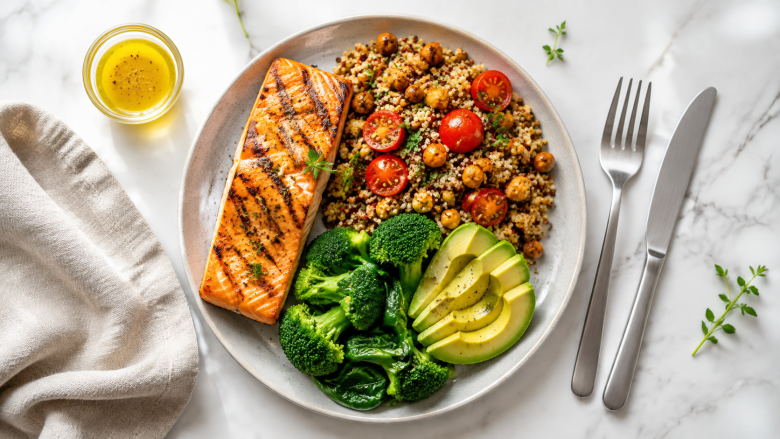
- 7:00 PM - Dinner: Baked salmon, roasted broccoli, and a small sweet potato.
This pattern ensures you never go more than 3 hours without eating, and every meal has the three macronutrients. Adjust portions based on your appetite and activity level.
When Balanced Eating Becomes Obsessive: A Word of Caution
While the plate method and 3-3-3 rule are excellent tools, they can become unhelpful if you start obsessing over every meal. I have seen people become so focused on eating "balanced" that they feel anxious if they eat a cookie or skip a vegetable. That is not healthy - it is a sign of orthorexia, or an unhealthy preoccupation with healthy eating.
The goal is to build a positive relationship with food, not to create more rules. If you are constantly worrying about whether your snack has the right ratio of carbs to protein, step back. The plate method is a guide, not a law. Some meals will be more balanced than others, and that is okay.
I encourage clients to use the 3-3-3 rule as a baseline, but also to listen to their bodies. If you are not hungry, do not force yourself to eat. If you are hungry between meals, add an extra snack. The system is meant to reduce stress, not increase it.
In fact, research on intuitive eating suggests that letting go of strict food rules can lead to better health outcomes than rigid dieting. A systematic review on intuitive eating found that it is associated with lower body mass index and better psychological health. So while the 3-3-3 rule provides structure, leave room for flexibility.
Final Thoughts: Start Small, Not Perfect
If you are new to balanced eating, do not try to change everything at once. Start with one meal a day - make it follow the plate method and set a timer for 3 hours after that meal. As you get comfortable, add the second meal, then the third. Within a couple of weeks, you will notice that you feel more energetic, crave fewer snacks, and have a calmer relationship with food.
The 3-3-3 rule plus the plate method is not a magic bullet. It is a practical framework that works because it addresses both the composition and the timing of your meals. It answers the "how" (what to put on your plate) and the "when" (how often to eat) that most guides ignore. Give it a try for a week, and see how your body responds. You might be surprised at how simple balanced eating can be.
And remember, balanced eating is not about perfection. It is about consistency. As long as you are eating a variety of real foods, with vegetables at the center, and you are eating regularly enough to avoid extreme hunger, you are doing it right. The rest is just details.