If you are reading this, you have probably already tried the standard advice. You have cut back on coffee, put your phone away an hour before bed, and tried to keep a consistent schedule. Yet you still lie awake at night, staring at the ceiling while your brain runs through tomorrow's to-do list.
I have been there. After years of experimenting with every sleep hack I could find, I learned that the generic tips only get you so far. The real breakthroughs came when I discovered specific, structured techniques that target the actual reasons we stay awake: racing thoughts, physical tension, and an overactive mind.
This guide covers the unusual, science-backed methods that go beyond the basics. You will learn the 3-3-3 rule for anxiety-driven insomnia, the Japanese breathing trick, the military method, and the cognitive shuffle. These are the micro-techniques that work when the standard advice fails.
Why the Standard Sleep Advice Is Not Enough
The typical sleep article tells you to avoid screens, exercise daily, and keep your bedroom dark. These are all valid, but they treat sleep as a purely physical problem. In reality, the biggest obstacle for most people is mental. According to the Sleep Foundation, stress and anxiety are among the most common causes of chronic insomnia.
When I worked with clients on sleep, I noticed a pattern. People who followed every basic rule still struggled because they had no strategy for what to do when they got into bed. They had no mental tool to stop their thoughts from spiraling.
The techniques below fill that gap. They are not replacements for good sleep hygiene. They are the tactical tools you deploy when your head hits the pillow and your brain refuses to switch off.
The 3-3-3 Rule for Sleep: A Structured Way to Stop Racing Thoughts
The 3-3-3 rule is a simple anxiety-reduction technique that has become popular among therapists and sleep coaches. It is designed to pull your brain out of the abstract worry loop and anchor it in the present moment. When I first tried it, I was skeptical because it seemed too simple. But the structured nature of the exercise is exactly what makes it effective.
Here is how it works, step by step:
- First, name three things you can see. Look around your room and identify three distinct objects. Say them silently in your head. A lamp. A water bottle. The edge of your dresser. The goal is not to analyze them, just to register them.
- Second, name three things you can hear. Listen carefully. You might hear the hum of the refrigerator, the wind outside, or your own breathing. If the room is completely silent, focus on the faintest sound you can detect.
- Third, move three parts of your body. This is the key physical component. Roll your ankles. Wiggle your fingers. Shrug your shoulders. The movement interrupts the physical tension that often accompanies anxious thoughts.
Why does this work? The technique forces your brain to engage with sensory input from your immediate environment. It interrupts the default mode network, which is the part of your brain that activates when you are worrying about the past or planning for the future. By redirecting your attention to specific, concrete details, you give your mind a break from the thought loop.
Most people make one critical mistake with this technique. They do it once, and when they are not asleep in two minutes, they assume it failed. The 3-3-3 rule is not a switch; it is a reset button. You may need to repeat the cycle three or four times before your mind settles. Think of it like a lullaby, not a sleeping pill.
If you want to combine this with a broader evening strategy, our guide on building a balanced bedtime routine covers how to structure the hour before you get into bed so you are not starting this exercise from a place of high arousal.
The Japanese Trick to Fall Asleep Fast: The 4-7-8 Breathing Method
When people search for the "Japanese trick" to sleep, they are usually looking for the 4-7-8 breathing technique. It was popularized by Dr. Andrew Weil, who calls it a "natural tranquilizer for the nervous system." The name comes from the pattern: inhale for 4 seconds, hold for 7 seconds, exhale for 8 seconds.
The magic of this method is in the extended exhale. When you exhale for longer than you inhale, you activate the parasympathetic nervous system, which is responsible for rest and digestion. This lowers your heart rate and blood pressure, signaling to your body that it is safe to relax.
Here is the exact sequence I recommend to clients:
- Place the tip of your tongue against the ridge of tissue just behind your upper front teeth. Keep it there for the entire exercise.
- Exhale completely through your mouth, making a soft "whoosh" sound.
- Close your mouth and inhale quietly through your nose for a mental count of 4.
- Hold your breath for a count of 7.
- Exhale completely through your mouth for a count of 8, making the whoosh sound again.
- Repeat the cycle for four full breaths at first, then gradually work up to eight breaths.
When I first practiced this, I made a critical error. I held my breath for seven seconds but did not actually breathe deeply during the inhale. The result was a panicky feeling and a racing heart. The key is to let your belly expand during the inhale, like a balloon filling with air. The breath should be slow and deep, not rushed.
The thing nobody tells you about this technique is that it takes practice. Your first few attempts will feel awkward. You might feel slightly lightheaded, which is normal. Do not force it. Start with four cycles, and only increase to eight when you feel comfortable.
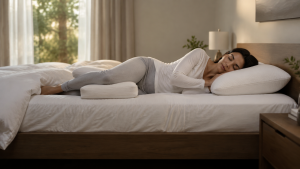
There is also a posture-based variation that some people call the Japanese trick. It involves lying on your back with a pillow under your knees to flatten your spine and reduce lower back tension. This position helps because it relaxes your psoas muscle, a deep hip flexor that often holds stress. For more on how posture affects your body, see our article on everyday tips for better posture. You can combine this position with the 4-7-8 breathing for a powerful physical and mental relaxation effect.
The Military Method: Fall Asleep in 2 Minutes
The military method is a technique that was developed to help fighter pilots fall asleep in under two minutes, even in stressful conditions. It is a physical and mental relaxation script that takes about 120 seconds to complete if you follow it precisely.
This is not a breathing exercise. It is a systematic body scan combined with a visual distraction technique. Here is the exact protocol:
- Relax your face. Start with your forehead. Let it go smooth. Relax your eyes, your cheeks, your jaw. Let your tongue rest at the bottom of your mouth. This is often the hardest part, because we hold tension in our jaw and brow without realizing it.
- Relax your upper body. Drop your shoulders as low as they will go. Let your arms fall loose. Relax your biceps, forearms, and hands.
- Relax your lower body. Breathe out and let your chest feel soft. Relax your thighs, then your calves, then your feet.
- Clear your mind. This is the mental component. The technique suggests you imagine one of two scenarios. First, you are lying in a canoe on a calm lake, with nothing but a clear blue sky above you. Second, you are lying in a black velvet hammock in a pitch-black room. Hold the image for 10 seconds.
- If thoughts intrude, repeat the phrase "don't think" to yourself until the image returns.
I have used this method on nights when I was wired after a stressful day. The body scan part is straightforward, but the visualization is where most people struggle. The first time I tried it, my "calm lake" kept turning into a choppy ocean with waves of anxiety. The trick is not to fight the intrusive thoughts. Just acknowledge them and return to the image.
This method works because it combines progressive muscle relaxation with cognitive distraction. The body scan reduces physical tension, while the visualization gives your mind a simple, non-stimulating task. It is particularly effective for people who have trouble with the 3-3-3 rule because it does not require you to engage with your environment, making it better for shared bedrooms or noisy environments.
One limitation is that it requires practice. In the original training, pilots practiced this for six weeks before they mastered it. Do not expect to nail it on the first night. Give it a week of consistent practice before you judge its effectiveness.
The Cognitive Shuffle: Mental Distraction to Stop the Chatter
The cognitive shuffle is a technique developed by cognitive scientist Luc Beaudoin. It is based on the idea that insomnia is often caused by worry and rumination, which are forms of high-level cognitive processing. The shuffle interrupts this by forcing your brain to engage in low-level, nonlinear thinking.
The method is simple. You think of a word with at least five letters. Then you take each letter of that word and think of a new word starting with that letter. For each new word, you picture the object in your mind's eye for a few seconds. The key is that the words should be completely unrelated to each other.
For example, using the word "sleeper":
- S - Satellite (picture a satellite orbiting Earth)
- L - Lighthouse (picture a lighthouse beam sweeping across the sea)
- E - Eggplant (picture a purple eggplant on a wooden table)
- E - Envelope (picture a sealed envelope)
- P - Pineapple (picture a pineapple with its spiky crown)
- E - Engine (picture a car engine)
- R - Raccoon (picture a raccoon's masked face)
This works because your brain is wired to predict patterns. When you worry, you are following a logical, predictable train of thought. The cognitive shuffle breaks that pattern. It creates a series of random images that do not connect, which your brain finds boring. The lack of coherence actually promotes sleep onset.
Most people who try this make the mistake of picking a word that is too short or too related to their worries. Avoid words like "stress" or "anxious." Pick a neutral, random word. If you find yourself building a story around the images, you are doing it wrong. The images should be disconnected and slightly absurd.
There are apps that do this for you, like mySleepButton, which plays random auditory cues to guide the shuffle. But you do not need an app. The manual method works just as well, and it keeps your brain occupied with a simple task rather than a glowing screen.
How to Get Better Sleep Every Night: A Practical Framework
You now have four powerful techniques. The question is how to combine them into a system that works every night. Here is the framework I use and recommend to others.
First, establish a basic sleep foundation. This is non-negotiable. You cannot out-hack a chaotic schedule. The CDC recommends aiming for 7 or more hours of sleep per night for adults. That means setting a consistent wake time, even on weekends, and making sure your bedroom is cool, dark, and quiet.
Second, have a layered response plan. Do not just repeat the same technique every night. Different nights require different tools.
- If you are feeling anxious about a specific event, use the 3-3-3 rule. The grounding nature of the exercise is perfect for anxiety spikes.
- If you are physically tense but mentally calm, use the 4-7-8 breathing. The extended exhale will lower your heart rate and release tension.
- If you are mentally wired with a thousand thoughts, use the cognitive shuffle. It is the best tool for an overactive mind.
- If you are generally restless and cannot settle, use the military method. It is a comprehensive reset for both body and mind.
Third, track what works. Keep a small notebook by your bed. After a week, you will see a pattern. Maybe the 3-3-3 rule works wonders on weekdays but fails on weekends. Maybe the military method only works if you also do the body scan twice. This data is gold. It turns your sleep practice from guesswork into a tailored system.
One of the most important lessons I learned is that sleep is not a performance. If you try all four techniques and you are still awake after 30 minutes, get out of bed. Go to another room, read a paper book under dim light, and wait until you feel sleepy again. This prevents the bed from becoming associated with frustration, which is the root of chronic insomnia.
For a deeper dive into the broader habits that support these techniques, our guide on building better sleep habits covers the daily routines that make falling asleep easier.
10 Tips for Better Sleep: The Essential Checklist
To answer the common question about what ten practical tips cover the full spectrum, here is my consolidated checklist. These are the core practices that support the micro-techniques described above.
- Keep a consistent sleep-wake schedule. Wake up at the same time every day, even on weekends. This anchors your circadian rhythm.
- Expose yourself to natural light in the morning. Get 10-15 minutes of sunlight within an hour of waking. This helps set your internal clock.
- Cut caffeine after 2 PM. Caffeine has a half-life of about 5-6 hours, meaning half of it is still in your system at 8 PM if you drink it at 2 PM.
- Limit alcohol, especially in the evening. Alcohol disrupts REM sleep, even if it helps you fall asleep faster.
- Create a cool sleeping environment. The optimal bedroom temperature is around 65 degrees Fahrenheit (18 degrees Celsius).
- Use the 4-7-8 breathing method. This is your go-to for lowering heart rate before bed.
- Apply the 3-3-3 rule for anxiety. Use it when your mind starts spinning with worries.
- Practice the military method for restlessness. Use it when you are physically wired but mentally exhausted.
- Try the cognitive shuffle for racing thoughts. Use it when your brain will not shut off.
- Get out of bed if you cannot sleep. After 20-30 minutes of wakefulness, move to another room and do a quiet activity until you feel drowsy.
The most important tip is to stop trying so hard. Sleep is a passive process. You cannot force it. You can only create the conditions for it to happen and then let go.
The Truth About "Sleep Hacks" and What Actually Works Long-Term
There is a lot of hype around sleep gadgets and supplements. Weighted blankets, smart sleep trackers, and melatonin gummies are everywhere. The truth is that these tools are accessories, not solutions. A weighted blanket will not fix an anxiety disorder. A sleep tracker will not teach you to relax.
What works long-term is a combination of behavioral consistency and mental techniques. The behavioral side is the foundation: regular schedule, proper light exposure, and a cool dark room. The mental side is the tools you have just learned.
The thing nobody tells you about sleep is that it is deeply influenced by how you spend your waking hours. If you spend your day in a state of chronic stress, your nervous system will be primed for vigilance when you get into bed. This is why our article on unwinding after work is so relevant. The transition from work mode to rest mode is a skill, and it takes time to build.
One honest limitation of these techniques is that they require mental effort. When you are exhausted, the last thing you want to do is count breaths or visualize a canoe. But that effort is precisely the point. You are giving your mind a structured task to prevent it from spiraling. The effort of the technique is less tiring than the effort of worrying.
If you have tried these methods consistently for several weeks and still struggle, consider seeing a sleep specialist. Chronic insomnia can be a symptom of underlying issues like sleep apnea, thyroid problems, or mental health conditions. The techniques in this article are powerful, but they are not a substitute for professional medical advice.
Putting It All Together: Your First Night Using These Techniques
Here is a practical plan for your first night trying these unusual methods. Do not try all four at once. Pick one and commit to it for a week.
Night One: Start with the 4-7-8 breathing. It is the most accessible and has the most immediate physical effect. Do four cycles, then roll over and try to sleep. If your mind starts racing, do not panic. Just repeat the breathing.
Night Two: Try the military method. Focus on the body scan. Pay special attention to your jaw and forehead, as these are common tension points. Use the canoe visualization.
Night Three: Use the 3-3-3 rule. This works best if you are feeling anxious. Name three things you see, three things you hear, and move three body parts.
Night Four: Try the cognitive shuffle. Pick a neutral word like "blanket" or "window" and work through the letters.
By the end of the week, you will know which technique resonates with you. Then you can build your personalized routine around it. The goal is not to master all four. The goal is to find the one that works for your specific sleep profile.
Sleep is a skill, and like any skill, it improves with practice. These techniques gave me my nights back. With consistent effort, they can do the same for you.