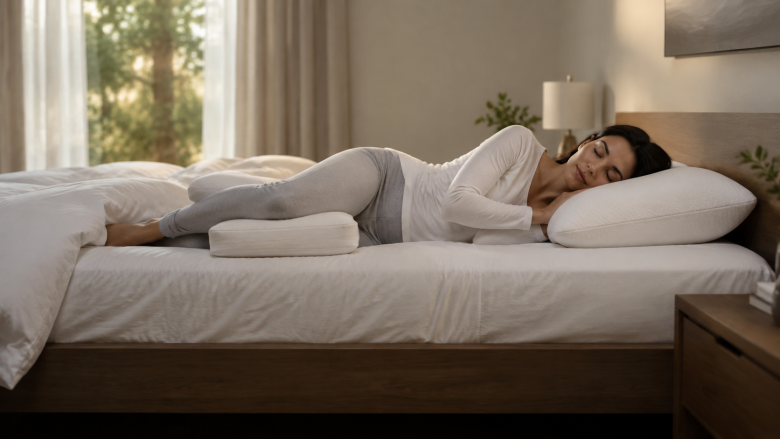
The Best Sleeping Position for Comfort Is the One You Can Fix
After a decade of coaching clients through chronic sleep issues, I can tell you this: there is no single "best" sleeping position. The healthiest position for your spine, airway, and digestion might be side sleeping, but if you wake up with a numb arm and a stiff neck every morning, you will not stick with it. Comfort is not about choosing a position from a chart - it is about making the position you actually sleep in feel good enough that you stop tossing and turning.
That is the missing piece in most advice. Articles tell you to sleep on your side for sleep apnea or on your back for acid reflux, but they never explain how to stop your shoulder from screaming or your lower back from arching into a painful curve. In this guide, I will walk you through specific, tested comfort hacks for each major sleep position - side, back, and stomach - plus a practical system for transitioning if you hate your current position. You will also get the truth about the "Japanese trick" and the 3:2:1 rule that actually works.
Here is the short answer to the question you came with: the best sleeping position for comfort is the one you can modify with the right pillows and props until your body stops complaining. For most people, that means side sleeping with a pillow strategy that supports your shoulder and neck. But I will show you how to make any position workable - and when to know that a position is simply wrong for your body.
Why "Healthiest" and "Most Comfortable" Are Often at Odds
Research consistently points to side sleeping as the most beneficial for overall health. According to the Sleep Foundation, side sleeping reduces snoring and mild sleep apnea, eases acid reflux, and can even help with lower back pain by keeping the spine aligned. Left-side sleeping is often recommended for pregnant women and for those with GERD because the stomach is positioned below the esophagus, reducing backflow.
But here is the catch: side sleeping is also the position that most people report as uncomfortable - especially if you have broad shoulders, a sore hip, or you are used to sleeping on your back. The classic complaint is waking up with a dead arm because the weight of your head and body pinches the nerves in your shoulder. The standard advice - "just put a pillow between your knees" - is not enough. You need to address the three pressure points: the shoulder, the hip, and the neck.
I remember the first time I tried to switch from stomach sleeping to side sleeping after a diagnosis of mild sleep apnea. I followed the basic guidance: pillow between knees, regular pillow under my head. Within two nights, my shoulder was throbbing and my arm went numb three times. I almost gave up. Then I started experimenting with how I positioned my arm and how thick my pillow was. That was the moment I realized that the "best" position is only as good as the adjustments you make to it.
The Real Problem: Pillow Height and Arm Placement
Most side sleepers use a pillow that is too thick or too thin. The goal is to keep your ear, shoulder, and hip in a straight line. If your pillow is too high, your neck bends upward, causing strain. If it is too low, your neck drops downward, causing a kink. The correct height depends on the width of your shoulder. A simple test: lie on your side without a pillow and place your hand on the top of your shoulder. The distance from your ear to the outside of your shoulder is the pillow height you need. For most people, that is between 4 and 6 inches, but a broad-shouldered man might need 6 to 7 inches, while a petite woman might need only 3 to 4.
The other fix is what you do with your bottom arm. The most common mistake is tucking it under your head. That lifts your shoulder and puts pressure on the brachial plexus, the bundle of nerves that runs through your armpit. Instead, extend your bottom arm straight out in front of you, at a 90-degree angle to your body, and rest it on the mattress. If you have a very soft mattress, your arm may sink and cause strain. In that case, use a thin pillow or a rolled towel to support your forearm, keeping it level with your shoulder.
Comfort Hacks for Side Sleepers: The Shoulder and Hip Fix
Once you have the pillow height right, the next pressure point is your shoulder itself. Even with perfect alignment, the weight of your head pushes down on the acromion process - the bony tip of your shoulder. This can cause pain and numbness, especially if you have a narrow bed or a firm mattress. The solution is a cut-out pillow or a pillow with a shoulder notch. These are contoured pillows that have a depression for your shoulder, allowing the pillow to cradle your head without pressing on the shoulder. They are not a gimmick; I have seen them transform sleep for people with rotator cuff issues.
If you do not want to buy a special pillow, here is a DIY hack: take a standard pillow and fold it in half, then place the folded edge under your head and let the open edge hang off the side of the bed. This creates a pocket for your shoulder. It is not perfect, but it works in a pinch. The key is to make sure your shoulder is not bearing the full weight of your head.
Your top arm also needs attention. If you let it flop over your side, it pulls on your shoulder blade and can cause upper back pain. The best position is to bend your top arm and place it on a pillow that sits at the same height as your shoulder. This is called the "position of comfort" for side sleepers. Many people find that hugging a body pillow helps because it gives your top arm and top leg something to rest against, reducing torsion in your spine.
The Hip and Knee Alignment
For your bottom hip, the pressure can be just as bad as the shoulder. If you have a bony hip or a hip replacement, you will feel it. The fix is to place a pillow between your knees - but not just any pillow. A thin, flat pillow that is exactly the width of your thigh bone is ideal. If the pillow is too thick, it tilts your pelvis and twists your spine. A folded blanket works too. The purpose is to keep your top leg from rolling forward, which would rotate your pelvis and put stress on your lower back.
Some side sleepers also benefit from a small pillow under their waist - especially if they have a big curve in their waist. This fills the gap between the mattress and your body, providing support and preventing the spine from sagging into a C-curve. You can use a rolled-up towel for this. I recommend using a contoured knee pillow that attaches to your leg, because it stays in place all night. I have tried the loose pillow method and it always ends up on the floor by 2 a.m.
If you wake up with a sore hip, try switching sides halfway through the night. That might sound obvious, but most people have a dominant side and never switch. Set a reminder on your phone to turn over at a certain hour. It takes a few weeks to build the habit, but it prevents the constant pressure on one joint.
Back Sleeping: Fixing the Lower Back Arch and Neck Strain
Back sleeping is often considered the second-best position for health because it keeps the spine in a neutral position. But if you have tight hamstrings or a natural lordosis (inward curve of the lower back), you might find that your lower back arches excessively, causing pain. The classic solution is to place a pillow or a rolled towel under your knees. This slightly flexes your hips and flattens the lumbar curve, reducing strain on the facet joints. The key is to use a pillow that is high enough to create a knee bend of about 30 degrees. A regular bed pillow folded in half usually does the trick.
Another common issue for back sleepers is neck pain from a pillow that is too thick or too thin. When you lie on your back, your head should be supported so that your forehead is slightly higher than your chin, and your neck is in a neutral position - not tilted forward or backward. A memory foam pillow with a contoured cervical roll is often recommended, but you can also use a thin, flat pillow and a rolled towel inside a pillowcase to create a custom neck support. The trick is to fill the space between the back of your neck and the mattress, not just under your head.
The 3:2:1 Rule for Pillow Placement (The One That Actually Works)
You might have seen the "3:2:1 rule" floating around social media. It is not a magic formula, but it is a useful mnemonic for back sleepers. The rule is: 3 inches under your head, 2 inches under your knees, and 1 inch under your lower back. These numbers are not exact for everyone, but they give you a starting point. Let me break down what each part does:
- 3 inches under your head: That is the thickness of a typical pillow. If you have a larger frame, you might need 4 inches. The goal is to keep your ear in line with your shoulder when viewed from the side.
- 2 inches under your knees: This is the height of a folded blanket or a small pillow. It should flex your knees just enough to press your lower back toward the mattress.
- 1 inch under your lower back: This is a rolled towel or a lumbar roll. Many people skip this, but it is essential if you have a pronounced arch. It fills the gap and prevents your back muscles from tensing up to stabilize you.
I have used this rule with dozens of clients, and it works because it forces you to think about the entire chain of support. Start with these measurements and adjust by a quarter inch at a time until you feel a comfortable, neutral stretch. The 3:2:1 rule is not a cure-all, but it is a far better starting point than the vague "use a pillow" advice you see elsewhere.
Why Back Sleeping Can Fail: The Rolling Problem
Even if you set up your back sleeping position perfectly, you might find yourself waking up on your side or stomach. That is because your body naturally moves into positions that relieve pressure. If you are a habitual side sleeper, your brain will try to turn you over. To prevent this, you can create a physical barrier. Place a body pillow on either side of you, or tuck a rolled-up blanket under your knees and then loop a towel around your waist to keep you from rolling. This is a temporary measure to train yourself, but it works.
Another reason back sleeping fails is that it worsens snoring and sleep apnea for some people. If you have untreated sleep apnea, sleeping on your back can make it worse because gravity pulls the soft palate and tongue backward. In that case, you might need to avoid back sleeping altogether, or use a positional device - like a backpack with a tennis ball sewn into it - to keep you on your side. This is a classic trick that has been used for decades, and it is still effective for positional sleep apnea.
Stomach Sleeping: The Unhealthiest Position, But You Can Make It Safer
Almost every health organization will tell you that stomach sleeping is the worst position. The Mayo Clinic notes that it puts pressure on joints and nerves, and forces your neck to be turned to the side for hours, which can cause neck and back pain. But if you are a die-hard stomach sleeper, you are not going to change overnight. The good news is that you can reduce the damage with a few adjustments.
The biggest issue is your pillow. Most stomach sleepers use a regular pillow, which elevates your head too much and cranks your neck into a painful twist. The fix is to use an ultra-thin pillow - or no pillow at all. When you sleep on your stomach, your head should be turned to one side, and the angle of your neck should be as close to neutral as possible. A thin pillow (1 to 2 inches) or a flat folded sheet can support your head without elevating it too much. If you have a very flat mattress, you might need a slightly thicker pillow to avoid hyperextending your neck.
The second fix is to place a pillow under your pelvis. This is a counterintuitive hack, but it works. When you sleep on your stomach, your lower back often sags into an exaggerated arch because your hips are pressed into the mattress. Placing a thin pillow under your hips (or under your lower abdomen) tilts your pelvis slightly, which flattens the curve and relieves pressure on your lumbar discs. You can also use a rolled-up towel. This is one of the most effective adjustments I have found for stomach sleepers, and almost no one mentions it.
The "Unhealthiest" Position Is Not Always Avoidable
I have worked with clients who have tried for months to switch from stomach sleeping to side or back, but they simply cannot fall asleep any other way. If you are one of them, do not beat yourself up. The key is to make your stomach sleeping as safe as possible: use a thin pillow, support your pelvis, and try to alternate which side you turn your head to each night. Also, consider a firmer mattress to prevent your hips from sinking too deeply, which worsens the arch.
One more thing nobody tells you about stomach sleeping: it can cause eye pressure and even lead to wrinkles over time, but that is cosmetic. The more serious risk is that it can compress your lungs and make breathing shallower, especially if you are overweight. If you wake up with morning headaches or fatigue, it might be a sign of poor breathing during sleep. In that case, you should seriously consider making a change. But if you are otherwise healthy, the comfort hacks above can keep you pain-free.
Transition Strategies: How to Change Your Sleep Position Without Losing Sleep
If you have decided to switch to a healthier position, the biggest hurdle is not the new position itself - it is your brain's automatic pilot. You will fall asleep on your back, but wake up on your stomach at 3 a.m. I have been through this, and I have coached many clients through it. The secret is to make the transition gradual and to use physical cues to prevent rolling.
Start with a 20-minute "trial" each night. Lie down in your target position, set a timer for 20 minutes, and simply read or listen to a podcast. You do not have to fall asleep. This teaches your body that the new position is not a threat. After a week, you can extend the trial to 30 minutes. Most people find that they drift off without realizing it.
Then, use the "pillow barrier" technique. Place a body pillow or a rolled-up blanket behind you if you are trying to stay on your side, or on both sides if you are trying to stay on your back. This physically prevents you from rolling. It is not foolproof - you might push the pillow away in your sleep - but it works for most people within two to three weeks.
Another effective strategy is the "tennis ball trick." Sew a tennis ball into the back of a snug-fitting t-shirt or a pajama top. When you roll onto your back, the pressure of the ball wakes you up enough to shift back to your side. This is a well-known behavioral technique used for positional sleep apnea. It is uncomfortable at first, but it is highly effective for breaking the habit. After about a month, you will find that you no longer need the ball because your body has learned to stay on its side.
What to Do When You Wake Up in the Wrong Position
Do not beat yourself up. Waking up on your stomach after a night of trying to sleep on your side is not a failure. The goal is not perfection; it is to spend a majority of the night in the healthier position. I tell my clients to aim for 60% of the night in the target position. That is enough to see benefits for snoring and back pain.
If you wake up in a position that causes pain, do not just lie there. Reposition yourself using the comfort hacks above, and then try to go back to sleep. Keep a pillow or prop within reach so you do not have to fumble in the dark. I keep a folded blanket at the foot of my bed specifically for this purpose - I can grab it and slide it under my knees without turning on the light.
The Truth About the "Japanese Trick" for Sleeping
You have probably seen videos online claiming that a "Japanese trick" for sleeping involves placing a rolled-up towel under your lower back or under your neck to fix posture. Some variations say to sleep on a flat wooden board or to use a special towel roll that aligns your spine. The truth is that there is no single Japanese trick, and most of these viral claims are oversimplified or outright false.
What is real is the concept of makura - the Japanese word for pillow - but traditional Japanese sleeping habits often involve a very low headrest or a buckwheat-filled pillow that provides firm support. The idea of using a towel roll under the neck is actually a common chiropractic suggestion, but it is not a magic fix. The "trick" is simply to align your cervical spine. You can achieve the same effect with a rolled towel, but you need to place it at the base of your skull, not under the middle of your neck. The position should support the natural curve, not exaggerate it.
Moreover, the viral "Japanese towel under the lower back" trick is often shown with a twisted body that looks like a pretzel - that is not a sleeping position. It is a yoga stretch called a spinal twist, and doing it while sleeping would be harmful. So be skeptical of any "trick" that promises instant posture correction. The only reliable method is consistent, ergonomic support over time. That means using the pillow heights and prop placements I have described, not a one-night gimmick.
How to Choose the Right Mattress for Your Preferred Position
No pillow setup can compensate for a mattress that is too soft or too firm for your body type. The best mattress for comfort depends on your sleeping position. For side sleepers, a medium-soft to medium-firm mattress is ideal because it allows the hip and shoulder to sink slightly, keeping the spine aligned. For back sleepers, a medium-firm mattress provides support without excessive sagging. For stomach sleepers, a firmer mattress is better to prevent the hips from sinking and arching the lower back.
If you are not ready to buy a new mattress, you can use a mattress topper to adjust the feel. A 2-inch memory foam topper can soften a firm mattress for side sleepers. A firm topper can add support to a sagging mattress for back or stomach sleepers. I have used this trick with clients who are on a budget, and it works surprisingly well. The key is to choose a topper that is dense enough to actually change the pressure distribution, not just a thin layer of fiber.
Also consider the size of your bed. If you sleep with a partner, you might be unconsciously moving toward the edge to avoid their body heat or movement. That can cause you to sleep in a cramped, twisted position. A larger bed - like a queen or king - gives you room to spread out and find your comfortable angle. If you have the space, upgrading your bed size is one of the most effective comfort investments you can make.
A Decision Matrix: Finding Your Personal Comfort Position
To make all of this actionable, I have created a simple framework. It is not a scorecard, but a way to think through your options based on your known pain points and health concerns.
| Your Situation | Best Position to Try | Key Adjustments |
|---|---|---|
| You snore or have mild sleep apnea | Side (left or right) | Pillow between knees, shoulder-friendly pillow, arm extended forward |
| You have acid reflux or GERD | Left side | Elevate head of bed 6 inches, use a wedge pillow, keep left side down |
| You have lower back pain | Back or side (with knee support) | Back: pillow under knees, lumbar roll. Side: thick knee pillow, waist support |
| You have neck pain | Back or side (with proper pillow height) | Cervical contour pillow, measure ear-to-shoulder height |
| You have shoulder pain | Back (if possible) or side with cut-out pillow | Use a shoulder-notch pillow, avoid sleeping on the affected side |
| You are pregnant | Left side | Full body pillow, pillow between knees, wedge under belly |
| You have varicose veins or edema | Back with legs elevated | Pillow under ankles to elevate legs above heart level |
This matrix is not exhaustive, but it gives you a starting point. The most important thing is to listen to your body. If a position causes sharp pain, numbness, or tingling, it is not the right one for you - regardless of what the charts say. I have seen people who sleep on their stomach with zero pain, and they are perfectly healthy. The "best" position is the one that lets you wake up refreshed and pain-free.
Final Thoughts: Comfort Is a Process, Not a Destination
When I first started writing about sleep, I thought the answer was simple: side sleeping for everyone. But after years of working with real people, I have learned that the human body is far too varied for one-size-fits-all advice. The best sleeping position for comfort is the one you can sustain night after night without waking up stiff, sore, or groggy. That might mean side sleeping with a specially angled pillow, back sleeping with a knee prop and a lumbar roll, or even stomach sleeping with a thin pillow and pelvic support.
The most important takeaway is this: do not force yourself into a position that feels unnatural. Instead, take the position you naturally gravitate toward and make it as ergonomic as possible. Use the comfort hacks I have outlined here - the 3:2:1 rule for back sleepers, the shoulder cut-out for side sleepers, the pelvic prop for stomach sleepers - and give each adjustment at least three nights to see if it helps. Sleep is a learned behavior, and your body can adapt to almost anything if you give it the right support.
Remember: the goal is not to achieve the "perfect" sleeping position. The goal is to wake up without pain, breathe easily, and feel rested. That is the only metric that matters.
If you are struggling with persistent discomfort, do not hesitate to consult a physical therapist or a sleep specialist. A professional can assess your alignment and recommend specific pillows or devices that match your body. But for most people, the adjustments I have described here will make a dramatic difference. Start with one change tonight - pick the position that gives you the most trouble and apply the relevant hack. You might be surprised by how quickly your sleep improves.