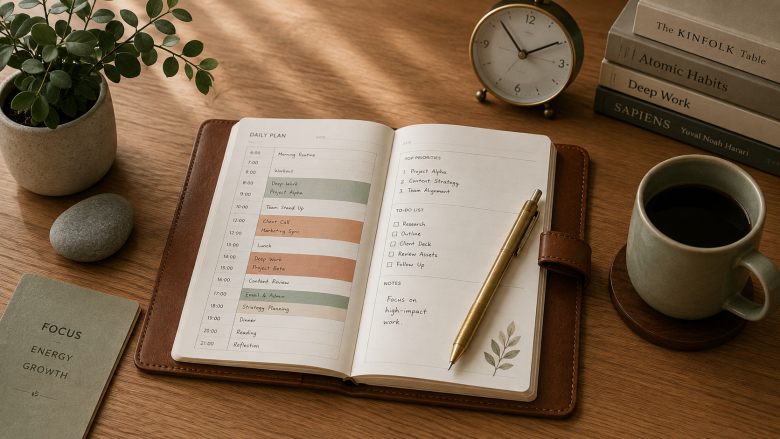
Why Your Schedule Keeps Failing (and It's Not Your Fault)
You can't stick to a schedule because you're treating it like a prison sentence, not a feedback loop. The standard advice - block your time, use a planner, set reminders - assumes the problem is organization. But the real problem is emotional friction. When you miss a task, you feel shame. That shame makes you avoid the schedule entirely, which leads to more missed tasks, and the cycle deepens.
I know this cycle intimately. When I first tried to build a structured day, I planned every hour from 6 a.m. to 9 p.m. I lasted three days. On day four, I slept through my 5:30 a.m. workout, felt like a failure by 7 a.m., and spent the rest of the week ignoring my planner out of sheer guilt. The schedule wasn't the problem. My relationship to it was.
The fix isn't more discipline. It's building a schedule that adapts to your energy, your brain chemistry, and your inevitable human messiness. This article walks you through a framework called energy-based adaptive scheduling, and it includes the exact restart protocol I use when things fall apart - because they will fall apart.
The Real Reason You Can't Stick to a Schedule
Let's answer the question directly: why can't I stick to a schedule? The most common reasons are not laziness or lack of willpower. They are perfectionism, cognitive overload, and a mismatch between your energy levels and your planned tasks.
Perfectionism Is Paralyzing You
Most people design a schedule like a perfect machine. Every hour is assigned, every minute is accounted for. When you inevitably miss one block - a meeting runs long, your kid gets sick, you just need a break - the entire system feels broken. Perfectionists don't do partial credit. If they can't do the full 7 a.m. to 8 a.m. workout, they skip it entirely and feel guilty for the rest of the day.
This is called the all-or-nothing trap. The research on goal pursuit is clear: the American Psychological Association notes that missing a single day doesn't derail habit formation, but the guilt and shame that follow a missed day often do. The missed workout isn't the problem. The spiral of self-criticism is.
Here's what I learned the hard way: a schedule is a tool for reducing decisions, not a moral test. When I stopped treating a missed block as a character flaw, I stopped abandoning the whole plan.
Your Schedule Is Too Heavy (Cognitive Load)
If your schedule requires constant attention to execute, it will fail. Each task on your list carries a cognitive load - the mental effort required to remember it, start it, and finish it. A schedule with 20 discrete tasks for the day is a recipe for overwhelm. Your brain sees the list, calculates the effort, and decides the couch is safer.
The solution is to reduce the number of decisions you make each day. This is why famous creators and executives wear the same clothes and eat the same lunch. They're not boring. They're protecting their cognitive bandwidth for the work that matters.
The Energy Mismatch Problem
Most schedules are built on clock time, not body time. They assume you can do deep, focused work at 2 p.m. because the calendar says so. But your body has its own rhythm, called your chronotype. Some people are morning larks, peaking at 8 a.m. Others are night owls, hitting their stride at 8 p.m. Forcing a night owl into a 6 a.m. workout is fighting biology.
The thing nobody tells you about scheduling is this: the best schedule is the one that matches your natural energy curve. If you're a night owl, your "9 a.m. deep work" block is wasted. Move it to 7 p.m. and suddenly you're productive.
How to Build a Schedule You'll Actually Follow
Let's shift from why schedules fail to how to make one that works. The process below is what I use with clients and what I use myself. It takes about 20 minutes to build, but the payoff is a schedule that bends instead of breaks.
Step 1: Track Your Energy, Not Your Time
For three days, carry a small notebook or use a notes app. Every hour, jot down your energy level from 1 to 5. Note what you're doing and how you feel. Don't judge it, just observe. After three days, look for patterns.
- When is your mental peak? (This is when you should do deep work like writing, coding, or strategic planning.)
- When is your social peak? (This is best for meetings, calls, and collaboration.)
- When is your physical peak? (This is for exercise or hands-on tasks.)
- When is your slump? (This is for admin, email, or low-effort tasks.)
This energy map becomes the skeleton of your schedule. I did this exercise and discovered my deep work window is 9:30 a.m. to 12 p.m., but my physical energy doesn't peak until late afternoon. So I stopped trying to run at dawn and moved my workouts to 5 p.m. The result? I've worked out more consistently in the last year than in the previous five.
Step 2: Apply the 3-3-3 Rule for Tasks
One of the most practical frameworks I've found is the 3-3-3 rule, popularized by Oliver Burkeman in his book "Four Thousand Weeks." The rule is simple: each day, decide on three things you want to accomplish, and give them three blocks of time. The structure looks like this:
- Three hours of deep, focused work on your most important project.
- Three smaller, medium-priority tasks that need to get done (emails, calls, admin).
- Three maintenance activities (dishes, laundry, stretching, reading, personal hygiene).
This rule works because it sets a ceiling on your ambition. You can't fit 20 tasks into a day, so you don't try. You pick three meaningful things and give them real attention. The 3-3-3 rule also answers the question of what to do when you're overwhelmed: shrink the scope to three.
I use this every day. My three deep hours are for writing, my three medium tasks are for client calls and emails, and my three maintenance tasks are for walking the dog, meal prep, and reading. It's boring, but it works.
Step 3: Anchor Your Schedule to Fixed Points
You need anchors - fixed times that don't move. These are your meal times, your work start time, your bedtime. Everything else on your schedule should be flexible around these anchors. Anchors give your day structure without turning it into a rigid prison.
For example, my anchors are: wake at 7 a.m., lunch at 12:30 p.m., dinner at 7 p.m., and lights out at 11 p.m. Within those anchors, I have flexibility. If a client call runs over, my afternoon shifts, but the anchors hold. This prevents the cascade failure that happens when one missed block destroys the whole day.
How to Stick to a Schedule When You Have ADHD
If you have ADHD, standard scheduling advice often backfires. Time blocking feels suffocating, planners become graveyards of good intentions, and the mere act of planning can drain your motivation. The key is to design for your brain's needs, not against them.
Use Body Doubling
Body doubling is a technique where you work alongside another person, either in person or virtually, who is also working on their own tasks. The other person doesn't help you; their presence just provides external accountability and reduces the friction of starting. There are dedicated sites like Focusmate that connect you with strangers for this purpose, or you can just call a friend and work together on mute.
I've used body doubling for years. When I can't start a task, I schedule a 50-minute Focusmate session. The act of showing up for someone else gets me to show up for myself.
Schedule Dopamine-Friendly Tasks
ADHD brains are dopamine-deficient, so tasks that don't provide immediate reward feel physically painful to start. The fix is to pair low-dopamine tasks with high-dopamine ones. Do 20 minutes of writing, then 5 minutes of a game on your phone. Or put on a playlist you love while doing admin work. This is called dopamine stacking, and it makes the schedule feel less like a punishment.
Use Time Blocking with a Timer, Not a Calendar
Instead of assigning tasks to specific clock hours, use a timer. Set a 25-minute Pomodoro session and commit to working on one task until the timer rings. When it rings, you're done, regardless of progress. This removes the anxiety of "I must finish this by 3 p.m." and replaces it with the manageable goal of "I just need to do 25 minutes."
For a deeper look at building sustainable habits around your daily structure, including how to fit in essentials like hydration, see our guide on how to drink more water on your busy schedule. It uses the same principle: small, low-friction actions beat grand gestures.
What to Do When You Fall Off the Wagon (The 2-Day Rule)
You will fall off. Everyone does. The difference between people who stick to schedules and people who don't is not the ability to avoid failure - it's the speed of recovery. This is where most advice fails, so listen carefully.
The 2-Day Rule Explained
Never miss two days in a row. That's the entire rule. If you miss a workout on Monday, you must do it on Tuesday, no matter how small. If you miss a writing session on Wednesday, you write 100 words on Thursday. The rule is simple because it's designed to break the shame spiral before it starts.
When I first started my schedule, I missed a workout due to a late night. The old me would have said, "Well, I've already ruined the week," and skipped the gym for the next five days. The new me woke up on Tuesday, did a 15-minute bodyweight circuit - far less than my usual 45-minute session - and kept the streak alive. That small win was enough to keep me coming back.
Most people don't realize that consistency is not about being perfect. It's about never letting a miss become a streak. The 2-day rule gives you permission to be human while keeping your identity as someone who follows through.
Restart Protocol: The 10-Minute Rule
If you've been off your schedule for more than two days, don't try to restart at full intensity. That's a trap. Instead, commit to a 10-minute version of your most important task. Write for 10 minutes. Exercise for 10 minutes. Meditate for 10 minutes. The goal is not output; it's to rebuild the neural pathway that says "I am someone who does this."
After 10 minutes, you can stop. In my experience, most people will continue past the 10-minute mark because starting was the hardest part. But even if you don't, you've won. You've proven to yourself that you can start again.
The Feedback Loop: Treating Your Schedule as a Living Document
A schedule is not a contract. It's a hypothesis. You test it, observe the results, and adjust. This is the mental shift that separates people who thrive with routines from those who choke on them.
Weekly Review Ritual
Every Sunday, spend 15 minutes reviewing the past week. Ask three questions:
- What drained my energy? (Cut or move these tasks.)
- When was I most focused? (Protect this time block aggressively.)
- Where did I consistently fall off? (This is a signal that the task is too big, too vague, or scheduled at the wrong time.)
This review turns failure into data. Instead of feeling bad about missing a task, you analyze why you missed it. The answer is often environmental: the task was too big, so it felt overwhelming. The fix is to break it into smaller pieces. Or the task was scheduled during your energy slump, so you delayed it. The fix is to move it to your peak.
I keep a spreadsheet of my weekly reviews. Looking back, I can see patterns I never would have noticed otherwise. For example, I discovered that I consistently skip tasks scheduled after 4 p.m. on Fridays. So I stopped scheduling important work then. I now use that time for low-effort admin and planning the next week.
Advanced Strategies for Different Life Circumstances
Not all schedules look the same. Your life circumstances - whether you're a shift worker, a parent, or a student - change what "sticking to a schedule" means. Here are a few advanced considerations.
For Shift Workers and Irregular Schedules
If your work hours change weekly, a fixed daily schedule is impossible. Instead, build a "pre-shift routine" and a "post-shift routine." These are small, fixed sequences that anchor your day regardless of the hours. For example, a pre-shift routine might be: wake up, drink water, stretch for 5 minutes, review your tasks. A post-shift routine might be: change clothes, wash your face, write down three things that went well. These routines give your brain a signal to transition, which is especially important when your clock is unreliable.
For Parents
Your schedule will be interrupted. Accept it. Build "buffer blocks" into your day - 30 to 60 minutes of unassigned time that you can use when the kids need you. This prevents the entire day from collapsing when a nap is skipped or a tantrum erupts. Also, consider scheduling your most important task during your child's most independent play time, not during nap time, because nap time is a gift you'll want to use for rest.
Tools and Apps: What Actually Helps (and What Doesn't)
I've tested dozens of scheduling apps, and most of them are just digital versions of paper planners. They don't solve the core problem, which is emotional friction, not organization. However, a few tools genuinely help.
For time-blocking: Google Calendar is fine, but I prefer Todoist because it lets me see tasks as a list, not a grid. The grid view makes me feel like a machine, and I rebel against machines.
For habit tracking: The app Habitica gamifies your habits. You get points and level up for completing tasks. It's silly, but it works for people who need a dopamine hit to stay engaged.
For focus: The Pomodoro technique works best with a dedicated timer. The app Pomofocus is simple and web-based. No signup required.
For body doubling: Focusmate is the gold standard. You book a video session, show up, and work alongside another person. It's deeply uncomfortable at first, and then it becomes addictive.
Here's what doesn't help: apps that send you constant notifications. Notifications add to cognitive load and remind you of what you're not doing. Turn them off. A schedule should be a tool you check, not a boss that nags you.
Trade-offs and Honest Limitations
Let me be honest about the limits of this approach. Energy-based scheduling requires self-awareness, and that takes time to build. If you're in a crisis - a major deadline, a family emergency - your schedule will fall apart, and that's okay. The goal is not to maintain a perfect routine in chaos; it's to have a routine to return to when the chaos passes.
Also, some people thrive on rigid structure. If you're someone who loves the feeling of a fully booked calendar, the adaptive approach might feel too loose. In that case, keep your time blocks but add the 2-day rule and the weekly review. Those two elements alone will prevent the shame spiral and keep you on track.
Finally, the 3-3-3 rule is not for everyone. It assumes you have three hours of deep work available. If your job is all meetings, you'll need to adapt it. Try a 1-3-3 rule: one hour of deep work, three medium tasks, three maintenance tasks. The principle remains: limit your daily ambition to a manageable number.
Your First 7-Day Plan to Test This Framework
Here's a concrete plan to start tonight. Don't try to implement everything at once. Pick one element and practice it for a week.
Day 1: Track your energy every hour using the 1-5 scale. That's it. No other changes.
Day 2: Identify your peak energy window from Day 1. Schedule one important task in that window tomorrow.
Day 3: Apply the 3-3-3 rule. Write down three deep tasks, three medium tasks, and three maintenance tasks. Do them in order of importance.
Day 4: If you miss a task, use the 2-day rule. Do a 10-minute version of it the next day. Do not skip two days in a row.
Day 5: Review your energy tracking. Move one task that consistently fails to a different time of day.
Day 6: Add a body doubling session for your hardest task, even if it's just a friend on a video call.
Day 7: Do a 15-minute weekly review. Write down what worked and what didn't. Adjust next week's plan based on that data.
This isn't a quick fix. It's a practice. The first week will feel clumsy. By the third week, you'll have a schedule that feels like it fits you, not the other way around.
The most important thing I can tell you is this: your schedule is not your master. It's a tool you use to protect your energy and your priorities. When you miss a day, you haven't failed. You've just collected data. Use that data to build a better system for tomorrow.