Why Your 'Deep Breaths' Are Making You More Anxious
You have probably heard it a thousand times: "Just take a deep breath." It is the default advice for stress, and it is frequently wrong. When I first started working with clients who had panic disorders, I saw a frustrating pattern. They would try the deep breathing they learned in a yoga class or from a wellness app, and instead of feeling calmer, they felt a rush of air hunger, dizziness, and a racing heart.
The problem is not the breath itself. The problem is how you breathe. For many anxious people, the standard "deep breath in" triggers a physiological chain reaction that looks exactly like a panic attack. The good news is that there is a specific fix: the exhale. This article explains why the exhale is the real stress lever, how to use a 2:1 ratio to activate your vagus nerve, and why you need two distinct protocols for acute panic versus chronic stress.
Yes, deep breathing does help with stress, but only when you do it the right way. The key is not how much air you pull in; it is how slowly you let it out.
The Paradoxical Breath: When 'Deep Breathing' Feels Like Drowning
Most people do not realize that hyper-focusing on your inhale is the fastest way to trigger hyperventilation. When I first began experimenting with breathwork, I made the mistake of trying to maximize the size of my inhale. I would pull air in until my lungs felt completely full, then immediately inhale again. Within sixty seconds, my fingers started tingling, my vision narrowed, and my chest tightened. I had accidentally induced a mild case of hyperventilation syndrome.
The scientific term for this is "paradoxical breathing" or "over-breathing." It happens when you take in more oxygen than your body's carbon dioxide levels can balance. Your blood vessels constrict, which reduces blood flow to the brain. That reduction causes dizziness, confusion, and a feeling of breathlessness. In other words, the harder you try to breathe deeply, the more your brain thinks it is suffocating.
The thing nobody tells you about deep breathing is that the inhale is the "sympathetic" breath. It is pro-arousal. It stimulates the heart. The exhale is the only phase of the breath cycle that directly engages the parasympathetic nervous system. If you are anxious, your inhales are already too long and too frequent. Adding more "deep inhales" is like pouring gasoline on a fire.
Key takeaway: The goal of stress-reducing breathwork is not to breathe more. It is to breathe less, and to specifically lengthen the exhale.
The relationship between anxiety and breathing is bidirectional. Anxiety makes you breathe faster and shallower, which lowers carbon dioxide, which makes you feel more anxious. To break this cycle, you have to target the exhale, not the inhale.
The Science of the Exhale: Vagus Nerve Activation Made Practical
The vagus nerve is the main highway of your parasympathetic nervous system. It runs from your brainstem down to your heart, lungs, and gut. When it is stimulated, it sends a signal to your heart to slow down and to your adrenal glands to reduce cortisol output. This is the physiological basis for why breathing exercises are often recommended for stress reduction.
Here is the nuance that most guides miss: the vagus nerve is not activated by breathing in general. It is activated by the mechanical stretch of the lungs during inhalation, and then more strongly by the pressure changes during a prolonged exhalation. A 2022 review in Frontiers in Physiology highlighted that respiratory sinus arrhythmia - the natural variation in heart rate with breathing - is more pronounced during the exhale. That variation is a direct index of vagal tone.
In simple terms: your heart rate speeds up slightly when you inhale and slows down when you exhale. The longer the exhale, the more time your heart has to decelerate, and the stronger the signal to your brain that it is safe to relax. This is why the exhale-to-inhale ratio is the single most important metric you can control.
Why the 2:1 Exhale-to-Inhale Ratio Works
If your exhale is twice as long as your inhale, you are maximizing the deceleration phase. For example, an inhale of 4 seconds and an exhale of 8 seconds gives your heart a full 8 seconds of slow-down time. This is not a gimmick; it is respiratory physiology.
The mechanism is called "respiratory sinus arrhythmia." During a long exhale, your heart rate drops, blood pressure slightly decreases, and the baroreflex (which regulates blood pressure) is reset. Over a period of 10 minutes, this practice trains your baseline nervous system to sit closer to the "rest and digest" state. It is a real, measurable biological change, not just a placebo.
I have seen clients who were skeptical of breathing exercises completely change their opinion once they switched from a balanced ratio (like 4-4 box breathing) to a 2:1 ratio. The difference is the difference between "lifting weights" and "stretching." Both are useful, but they do different things.
The Two-Pronged Protocol: Rescue Breathing vs. Training Breathing
One of the biggest gaps in how people talk about breathing for stress is that they conflate two very different situations. You cannot use the same technique for a panic attack that you use for a daily 10-minute practice. It would be like using a fire extinguisher to water your lawn. You need two distinct tools.
Protocol 1: The 5-Second Rescue Box (For Acute Panic)
When you are in the middle of a panic attack, your blood carbon dioxide levels are already low. Your brain is screaming for oxygen, but the real problem is that you have blown off too much CO2. In this state, the last thing you want to do is take a huge inhale. You need to increase CO2, which paradoxically means you need to reduce your breathing volume.
Instead of a classic box breath (4-4-4-4), I recommend a shorter, exhale-dominant version. This is a "rescue" pattern designed to be done for 5 seconds. It is not a training tool.
- Inhale through the nose: 2 seconds only. Keep it quiet and gentle, like you are sipping through a straw.
- Exhale through the nose or mouth: 4 seconds. Make it a long, slow sigh. Let your shoulders drop.
- Pause: 2 seconds. Do not force it. Just let the air be still.
- Repeat: Only for 5 total cycles. Then stop and assess.
This works for three reasons. First, the short inhale prevents you from over-breathing further. Second, the 2:1 ratio immediately forces the vagal brake on your heart. Third, the finite count (5 cycles) gives your brain a task to focus on, which interrupts the catastrophic loop of "I am dying" thoughts.
I remember a client who used to avoid flying because of panic attacks. She tried the slow deep breathing that her therapist suggested, but it made her feel worse because she felt like she could not get a full enough breath. When we switched to this 2-second inhale / 4-second exhale pattern, she was able to board a plane within two weeks. The key was that she stopped trying to take a "deep" breath and instead focused on the exhale.
Protocol 2: The 10-Minute Training Practice (For Baseline Stress)
Acute rescue breathing is for emergencies. To actually change your baseline stress level, you need to train your nervous system daily. This is similar to how you cannot build muscle by doing one push-up before a stressful meeting. You need consistent repetition.
The training protocol is longer and more relaxed. It does not have a fixed ratio because the goal is to find a rhythm that feels sustainable. I recommend starting with a 4-6 ratio (inhale 4, exhale 6) and gradually working up to a 5-10 ratio over the course of a few weeks. The key is to never force the breath. If you are gasping for air, you are pushing too hard.
Here is the structure I use with clients:
- Time: 10 minutes, at roughly the same time each day. Morning works best for most people because it sets the tone for the day, but an afternoon break is also effective.
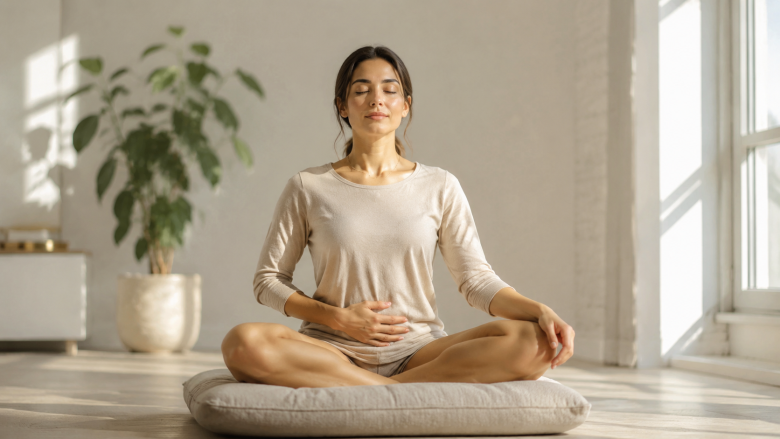
- Posture: Sit upright but relaxed. No slouching. A straight spine makes it easier for your lungs to expand fully.
- Focus: Count your breaths. Inhale for 4, exhale for 6. Do not add a pause yet.
- Progression: After one week, lengthen the exhale to 7 counts. After two weeks, try 8. The inhale stays at 4 counts.
- Tool: I personally use the OXA breathing device because it gives visual biofeedback on your exhale rate, but you can just as easily use a phone timer or even a metronome app like Pro Metronome set to 60 BPM to pace yourself.
The goal of the 10-minute session is not to become calm in that moment. It is to build "vagal tone" over time. Think of it as progressive overload for your nervous system. Just as lifting weights makes your muscles stronger, these extended exhales make your vagus nerve more efficient at putting the brakes on stress responses.
If you want a full breakdown of how to structure a daily routine, see our guide on how to practice breathing exercises daily. For an immediate primer on the basics, our article on instant calm breathing techniques covers the 4-4-4 box breath, but this article is about fixing its limitations.
How to Manage Stress and Anxiety When Breathing Is Not Enough
Breathing is a powerful tool, but it is not a silver bullet. The relationship between anxiety and breathing is strong, but it is not the whole story. If you are chronically stressed, your breathing patterns are likely part of a larger system that includes sleep, caffeine, diet, and how you interpret your own emotions.
I see many people who become obsessed with breathing as a cure-all. They do 30 minutes of pranayama a day but still drink 400 mg of caffeine and stare at their phone for two hours before bed. That is like trying to cool a house by opening a small window while the furnace is on full blast.
To manage stress and anxiety effectively, use breathing as one tool in a toolbox. Here is what works:
- Address the root cause: Identify the specific stressor. Is it a job, a relationship, or your inner critic? Breathing can help you cope, but it cannot fix a toxic situation.
- Physical movement: A 20-minute walk at a brisk pace does wonders for resetting your nervous system. Pair it with the 2:1 breathing from Protocol 2.
- Sleep hygiene: Your body's stress response is heavily regulated by sleep. If you are sleeping less than 6 hours, your cortisol is already elevated. No breathing technique will override that.
- Caffeine moderation: Caffeine is a sympathetic nervous system stimulant. It makes you more sensitive to adrenaline. Consider cutting off caffeine after noon.
- Journaling: Sometimes your stress is just a backlog of unsorted thoughts. For a structured way to unload, see our journaling guide.
If you want a broader look at stress-reduction tactics, our article on quick daily stress reduction tips lists several evidence-based strategies that complement a breathing practice.
The Exhale Is the Skill, Not the Inhale
After years of practice and teaching, the single most important lesson I have learned is that the exhale is the skill. Most people do not realize that a "deep breath" does not have to be a long inhale. In fact, a long inhale is often counterproductive for anxious individuals.
Try this experiment right now: Place one hand on your belly and one on your chest. Inhale through your nose for a 3-second count. Then exhale slowly through your mouth for a 6-second count. Notice how your heart rate settles. That is not your imagination. That is your vagus nerve being recruited to calm you down.
The 2:1 exhale rule is not a rule for everyone all the time. It is a targeted intervention for the population that is most sensitive to the adverse effects of over-breathing: people with anxiety. If you do not have anxiety, a balanced box breath may be perfectly fine. But if you have ever felt that deep breathing made you feel worse, you now know why. You were doing the right concept with the wrong ratio.
Step-by-Step: Building Your 2:1 Daily Routine
Here is my exact process for setting up a daily 2:1 breathing practice. It takes less than 15 minutes, and you can do it sitting at your desk or lying in bed.
- Set a timer for 10 minutes. Use a countdown timer so you are not checking the clock.
- Get comfortable. Sit upright in a chair, or lie on your back with your knees bent. The goal is to have your chest open.
- Start with a natural exhale. Do not start with an inhale. Exhale completely, then let the inhale happen passively.
- Count your inhale. Inhale through your nose for 4 seconds. Focus on the expansion of your belly, not your chest.
- Count your exhale. Exhale through your nose or mouth for 6 seconds. Really let the air out slowly, like you are breathing onto a window to fog it up.
- No pauses. Do not hold your breath after the inhale or the exhale. Just a smooth, continuous loop.
- Progress slowly. Each week, increase the exhale count by 1 second. Inhale stays at 4. After 4-6 weeks, you should be at a 4-8 or 4-10 ratio.
- Troubleshoot. If you feel dizzy, you are exhaling too hard. Ease up a bit. The exhale should be gentle, not a forceful blast.
What Can Go Wrong (And What to Do About It)
Every practitioner has had clients where breathing exercises caused more harm than good. It is important to know the failure modes so you can avoid them.
The Dizziness Trap: If you feel lightheaded, you are blowing off too much CO2. Stop immediately and breathe normally. The next session, reduce your exhale length by 2 seconds.
The Exhale Pushing Problem: Some people get so excited about the exhale that they try to push the air out with force. This only creates tension. The exhale should be a controlled release, like a balloon deflating, not a forced pump.
The Obsessive Counting Problem: There is an irony that anxious people turn their breathing practice into another performance. If you find yourself getting frustrated that your counts are not perfect, you are missing the point. The 2:1 ratio is a guideline, not a legal contract. It is better to have a loose 5-second exhale than a perfect 8-second one that makes you feel like you are failing.
When to Seek Medical Help: If you have asthma, COPD, or any respiratory condition, always consult your doctor before starting any new breathing practice. While breathwork can be deeply beneficial for many chronic conditions, it is not a substitute for medication, and certain techniques can trigger bronchospasms.
The bottom line: Deep breathing does help with stress, but only if you respect the exhale. Use the 5-second rescue protocol for acute panic. Use the 10-minute daily training protocol to build baseline resilience. And never force a breath that feels uncomfortable.
When you get the 2:1 ratio right, the results are not dramatic or mystical. They are physiological. You feel a subtle drop in heart rate, a slight warm feeling in your hands, and a quieting of the mental noise. That is your nervous system finding its way back to equilibrium. It is a skill you build, not a pill you take. But once you have it, it is always with you.